Pergola Cost in Metro Vancouver (2026): Cedar, Aluminum & Louvered Pricing
Quick Answer
In 2026, a standard cedar pergola in Metro Vancouver runs $45–$70 per sq ft installed — roughly $6,500–$10,000 for a typical 12'×14' structure. Powder-coated aluminum runs $55–$90/sq ft, and motorized louvered aluminum roof systems run $120–$220/sq ft, or $15,000–$35,000 for a mid-size covered patio. Attached pergolas with a solid or louvered roof need a building permit in most Metro Vancouver municipalities.
A pergola is one of the highest-ROI additions you can make to a backyard in this climate — it turns a deck or patio from "usable on sunny days" into "usable most of the year." But pergola pricing spans a huge range, from a $2,000 kit to a $35,000 motorized system, and the material and roof type you pick matters more than almost anything else.
Here's what we're actually quoting across New Westminster, Burnaby, Coquitlam, Port Moody, Langley and the rest of the Lower Mainland in 2026.
2026 pergola pricing by material and roof type
Cedar open-lattice pergolas run $45–$70 per sq ft installed. Powder-coated aluminum runs $55–$90 per sq ft. Motorized louvered aluminum runs $120–$220 per sq ft. A typical 12'×14' structure therefore ranges from about $7,500 to $37,000 depending on the roof system.
These figures reflect what we quote in Metro Vancouver in 2026, including posts, footings, beams and standard hardware. They assume a straightforward ground-level or low-deck installation — attached to the house or freestanding in the yard.
| Pergola type | Installed price / sq ft | Typical 12'×14' (168 sq ft) |
|---|---|---|
| Cedar, open lattice | $45 – $70 | $7,500 – $11,800 |
| Cedar, solid or slatted roof | $60 – $85 | $10,000 – $14,300 |
| Powder-coated aluminum, open | $55 – $90 | $9,200 – $15,100 |
| Vinyl, open lattice | $40 – $65 | $6,700 – $10,900 |
| Motorized louvered aluminum | $120 – $220 | $20,200 – $37,000 |
Why cedar and aluminum land so differently
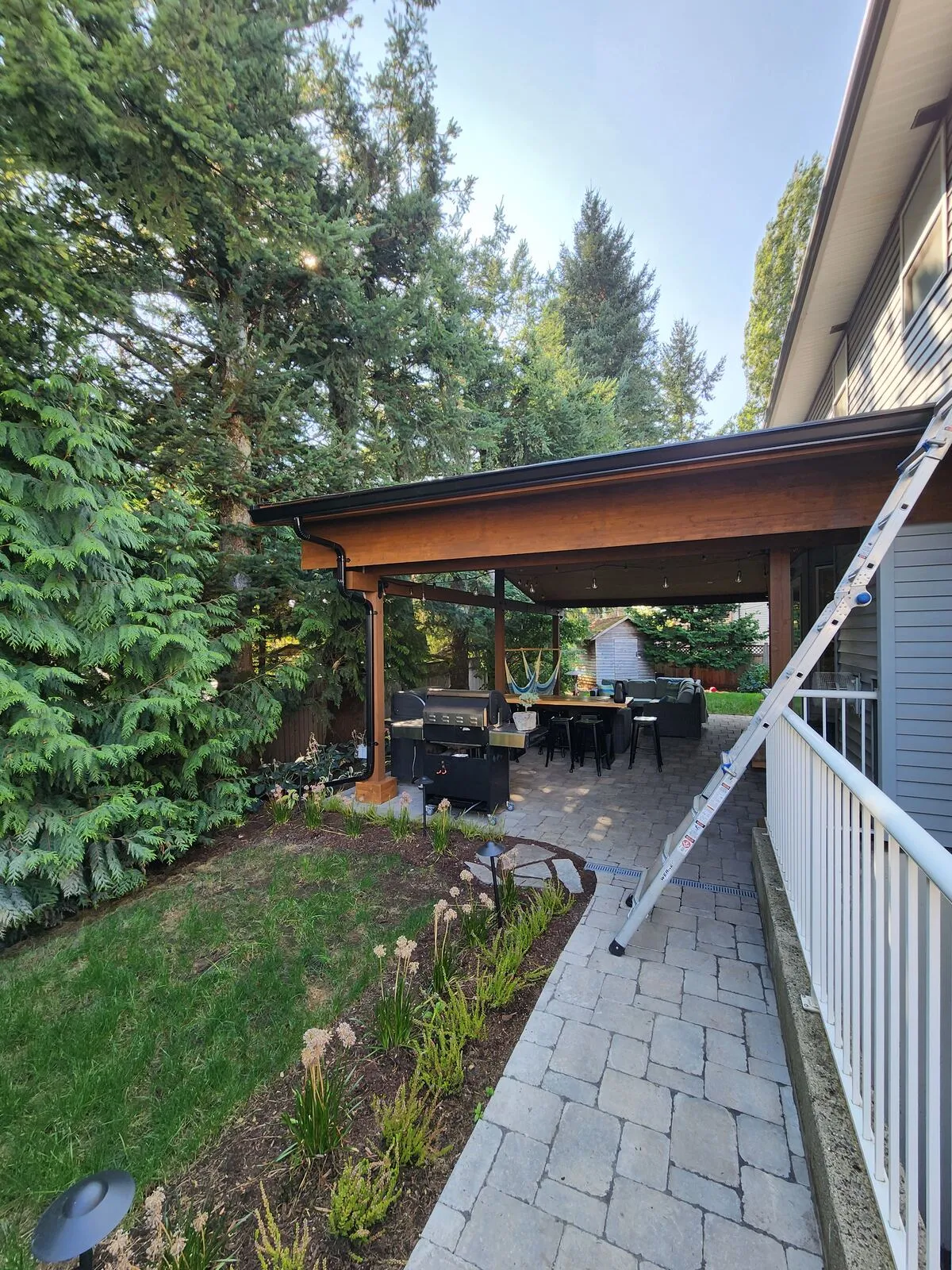
Cedar is the classic look for a reason — it's warm, it's local, and it ages well if it's maintained. It needs restaining every 2–3 years in our wet climate to avoid greying and checking, and untreated cedar posts in ground contact will eventually need attention. It's the mid-price option and the one most homeowners picture when they think "pergola."
Aluminum costs more up front for a comparable open structure, but it's essentially zero-maintenance — no staining, no rot, and it holds up to decades of coastal rain without attention. Powder-coated finishes now come in wood-look textures that close the visual gap with cedar.
Motorized louvered systems are their own category. The aluminum blades rotate to give you full sun, full shade, or fully closed rain protection at the push of a button. They're engineered structures required to handle Metro Vancouver's roughly 1.0 kPa snow load, which is why the price jumps so much from an open lattice pergola.
What moves the price beyond the roof material
- › Attached vs. freestanding — an attached pergola ties into the house fascia and needs proper flashing to keep water out of the wall; freestanding structures need their own footings on all four corners but skip the flashing detail.
- › Height and post size — taller pergolas for headroom over a raised deck need larger posts and deeper footings.
- › Electrical — string lighting, a ceiling fan or heaters add $800–$3,000 depending on scope and whether new circuits are needed.
- › Screens or curtains — retractable bug screens or privacy curtains on a louvered system add $2,000–$6,000.
- › Foundation type — a pergola built over an existing deck uses the deck structure; one built over grass or gravel needs concrete footings, adding $400–$1,200.
Do you need a permit for a pergola in Metro Vancouver?
Small, freestanding, open-lattice pergolas under local size and height thresholds are often exempt, but anything attached to the house, oversized, solid-roofed or motorized typically requires a building permit. Louvered systems may also need engineering for snow load.
An open lattice pergola under about 10 m² (107 sq ft) and under 600 mm off grade is often exempt in many Lower Mainland municipalities — but every city sets its own threshold, so always confirm before building. Once a pergola is attached to the house, over that size, or has any roof covering — including solid roof, polycarbonate panels or a motorized louvered system — most municipalities require a building permit, the same way a deck cover does.
We handle the permit application as part of the job on anything that needs one — it's a routine part of the process, not an extra step you have to chase down yourself.
Getting an accurate pergola quote
Per-square-foot ranges get you a budget, but the real number depends on your yard's grade, whether you're attaching to the house, and which roof system you want. We do a site visit, talk through open vs. covered vs. motorized, and give you a written quote — usually within a few days.
Valart Solutions builds pergolas across New Westminster, Burnaby, Coquitlam, Port Moody, Port Coquitlam, Langley and the rest of Metro Vancouver. Site visits and quotes are free.
Frequently Asked Questions
How much does a 12×14 pergola cost in Vancouver in 2026?
Roughly $7,500–$11,800 in cedar with an open lattice roof, $9,200–$15,100 in aluminum, and $20,000–$37,000 for a motorized louvered aluminum system — installed, before electrical or screens.
Is a pergola worth it if I already have a covered deck?
Yes, if the covered area is small or shaded on the wrong side of the day. A pergola over the uncovered portion of a deck or patio extends usable outdoor space without a full roof addition, and a louvered system gives you sun control the deck cover alone can't.
Do pergolas need a permit in Metro Vancouver?
Small, freestanding, open-lattice pergolas are often exempt below certain size and height thresholds, but rules vary by municipality. Anything attached to the house, oversized, or with a solid or motorized roof typically requires a building permit and, for louvered systems, engineering for snow load.
What's the best pergola material for Vancouver's rainy climate?
Aluminum and vinyl require the least maintenance in a wet coastal climate and won't rot or need restaining. Cedar looks warmer and is the most popular choice, but budget for restaining every 2–3 years to keep it from greying and checking.